1. Losing your old pages when you move your website
A London psychiatry clinic had a page ranking first on Google for a search made 700 times a month. After the new website launched, that address said "Page not found". At a Mayfair clinic, seven of its ten best old pages had been sent to the new homepage instead of the matching pages.
That search gave the London clinic a chance to be found by people looking for its service 700 times a month. An assessment cost £1,160. One booking a month would be nearly £14,000 a year, which shows the potential value of that broken page. It isn't a measurement of lost revenue. Google also drops error pages over time, so leaving it broken puts the ranking at risk.
Before moving a website, list every page that gets traffic. Each old address needs to point to the matching new page. Once the site is live, check Search Console for "Not found" errors every week for the first month.
2. Pages Google can't see
A Hertford clinic had 12 good treatment pages, and only a quarter of them appeared in Google. A Pinner studio's booking page was set to be hidden from Google, even though every Book Now button led to it.
The Hertford clinic had paid for 12 pages, and three quarters weren't visible. Until it fixed the underlying problem, paying for more content would mean more pages patients couldn't find.
Open Indexing, then Pages, in Search Console. Check which pages aren't indexed and why. Make sure important pages aren't set to "noindex", then request indexing for each one.
3. Choosing the wrong Google category
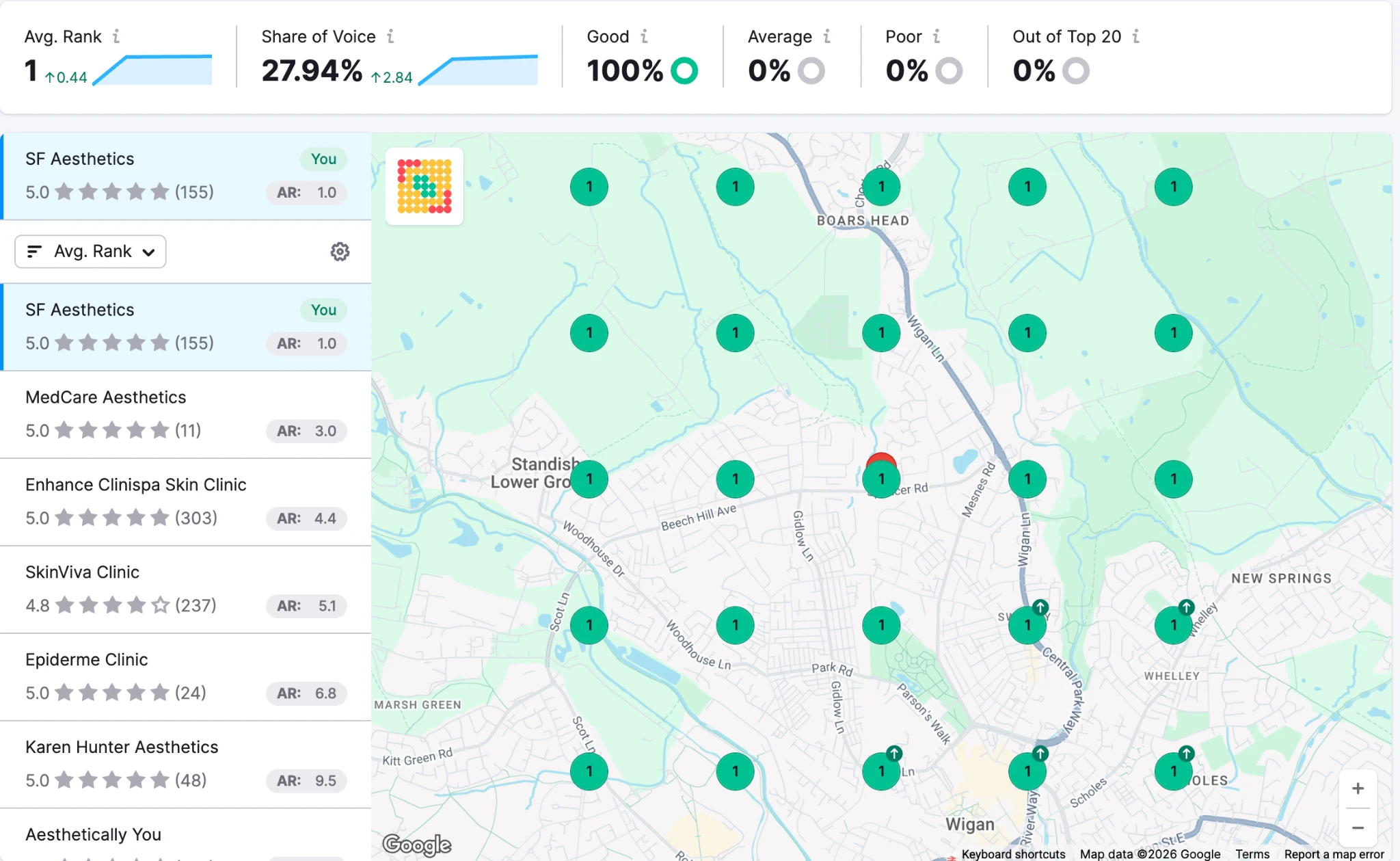
A Mayfair clinic was listed on Google as "Clinic". Across the 25 map points I checked, it didn't appear in the top 20 anywhere. Most of the clinics doing well for that search used "Skin care clinic".
It had 54 five-star reviews, more than two of the four clinics ahead of it on the map. The reputation was there. Its Google category wasn't helping patients find it.
Search your main treatment and town. Look at the categories used by the top three clinics, then choose the closest accurate match for your primary category. Use relevant secondary categories for the other services you provide.
4. Your details are different everywhere
One clinic had three different Kingston addresses online. Google's AI sent patients to a street it wasn't on. Across the nine clinic audits, five had a name, address or phone number that changed from one site to the next.
Imagine booking a treatment, getting ready to pay and arriving at the wrong door. Mismatched details also make it harder for Google and AI tools to establish where you are and show patients the right information.
Choose one exact version of your clinic name, address and phone number. Use it on your website and Google profile, then check social media, Treatwell, Fresha and the directories you're listed on.
5. No named practitioner
A fat freezing clinic had a "Meet Our Team" heading with nobody underneath it. ChatGPT recommended a rival and gave its named practitioner as the reason.
The clinic came first on ChatGPT for its own town and third across the county. Yet a basic detail was missing from its website. Adding the practitioner information could have been an afternoon's work.
Show who works at your clinic. Add each practitioner's name, qualifications and registration, with a short bio and photo. Link to the register they're on, such as the NMC register or GMC register.
6. Hiding your prices
A Mayfair clinic showed prices on 0 of its 18 treatment pages. ChatGPT named a Pinner studio in all three answers I checked, but never first. It described the studio's rates as "on enquiry". The rival it placed first published a price of £65 an hour.
If patients can't find your prices, they may keep looking until they find a clinic that shows them. The same missing information can leave AI tools with less to say about you when they compare options.
Put a "from" price on each treatment page where the advertising rules allow it. Give patients enough information to understand the likely cost before they enquire.
7. Making people work to book
A salon's first homepage button said "Contact us for more information". Its phone number couldn't be tapped to call. A Chichester clinic had no online booking at all.
The Chichester clinic appeared in the top three on the map across half the city and had a perfect 5.0 rating. Someone finding it at ten at night still had to send a form and wait. The salons above it let people book there and then. Getting found was only part of the job.
Make the first button say "Book now" and take patients to the booking page. Check that your phone number can be tapped and that online booking works properly on a phone.
8. Every treatment on one page, or copied town pages
One Chichester clinic had 16 treatments on a single page. A salon had ten location pages with just 4 words different out of 408.
There were about 850 local searches a month for the Chichester clinic's treatments, but it wasn't appearing for any of them. "Massage Chichester" alone gets 450 searches a month. The clinic offered it without giving it a page of its own. Near-identical town pages bring a different problem: they can fall foul of Google's spam rules.
Give each main treatment a page that answers what patients need to know. If you serve several towns, make those pages useful to people in each place. Add real local details, directions and relevant patient reviews, rather than swapping the town name.
9. Posting for likes, not bookings
Across the audits, clinics were busy on social media. Too often, the posts stopped at views. Someone interested in booking wasn't given a clear next step.
Filming and editing take hours. If the posts don't lead people towards an enquiry, you can spend a whole week on content and still have gaps in the diary.
Track saves and shares, then DMs and link clicks. Give each post one clear next step and link your bio straight to booking. My guide on how to get more clients from Instagram for an aesthetic clinic goes through this in detail.
10. Naming prescription medicines on social media
I regularly find prescription-only medicines named in clinic captions, hashtags and on-screen text. It's one of the most common advertising problems I see on social media.
An ASA ruling can be published with your clinic's name on it. A post can also be reported to your regulator. A caption deserves the same care you'd give the rest of your professional work.
Focus on your consultation and expertise without directly or indirectly promoting a prescription medicine. Check the ASA advertising codes and MHRA guidance before posting. Leaving out the product name isn't enough on its own.